Wat Phnom in Phnom Penh: A Majestic Icon
Wat Phnom in Phnom Penh, in the heart of Cambodia’s capital, stands as one of the most iconic and revered landmarks in the city.
This ancient temple, towering above the bustling streets and modern cityscape, offers a unique window into Cambodia’s rich cultural and religious heritage.
In this post, we will delve deep into the history, significance, architecture, and cultural impact of Wat Phnom, shedding light on why it remains an essential destination for anyone visiting Phnom Penh.
A Glimpse into History: The Origins of Wat Phnom in Phnom Penh
The story of Wat Phnom dates back to the 14th century, a time when Phnom Penh was a small settlement.
According to legend, the temple’s creation is tied to a revered figure named Donn Penh, a wealthy widow who lived in the area.
The tale goes that Donn Penh discovered four statues of the Buddha washed up along the riverbank.
She decided to build a small hill, or “phnom” in Khmer, to house these statues.
This small hill would later become Wat Phnom, and it is said to have been the foundation for the city itself.
The name Phnom Penh (literally, “Penh’s Hill”) is derived from this very event.
The story is a mix of mythology and local history, showcasing the strong ties between religion and the development of the city.
Today, Wat Phnom remains a symbol of Phnom Penh’s growth and historical significance, standing proudly on a 27-meter hill that overlooks the city.


The Significance of the Temple’s Location
Wat Phnom is strategically located in Phnom Penh’s city center, yet its elevation above the surrounding streets offers a peaceful escape from the urban chaos below.
The hill on which the temple stands is one of the few natural elevations in an otherwise flat area, adding to its mystical allure.
This location was likely chosen because of the symbolism of elevation in many religious practices, particularly Buddhism.
The higher the place of worship, the closer it is to the divine, and the more sacred it becomes.
In addition, the location of Wat Phnom, facing towards the Tonle Sap River, allows it to be in alignment with various other sacred sites in the city.
This adds to its role as an important religious axis, bringing the surrounding landscape into harmony with the temple’s spiritual purpose.
A Sacred Place: Spiritual and Religious Significance
Wat Phnom is not just a beautiful temple; it is a sacred space for Buddhists.
As the highest point in Phnom Penh, it has long served as a place of prayer, reflection, and spiritual connection.
The temple is dedicated to the Buddha, and like many other religious sites in Cambodia, it follows the traditions of Theravada Buddhism, the dominant form of Buddhism practiced in the country.
Every year, thousands of worshippers visit Wat Phnom to pay homage, seek blessings, and perform various religious rituals.
The temple is especially busy during the Buddhist holiday of Vesak, which celebrates the birth, enlightenment, and death of the Buddha.
During this time, the temple becomes a hub of activity with offerings, prayers, and a palpable sense of devotion in the air.
Monks are a prominent feature of Wat Phnom, and visitors often see them walking around the temple grounds in their saffron robes, performing sacred chants and rituals.
The temple is also an important place for pilgrims who come from all over Cambodia and even from other countries in Southeast Asia.
Additionally, Wat Phnom is famous for being a site where many local Cambodians come to make wishes.
It is common for visitors to walk around the temple three times, each time making a wish or offering a prayer for good fortune.
This act of walking around the stupa, called “circumambulation”, is rooted in Buddhist tradition and symbolizes the cycle of life, death, and rebirth.


Architectural Beauty: A Blend of Khmer and Colonial Styles
Wat Phnom’s architectural design is a striking blend of traditional Khmer and colonial influences, reflecting Cambodia’s cultural diversity and its historical encounter with foreign powers.
The temple’s layout features a central stupa that houses the Buddha statues, surrounded by several smaller shrines and statues, each with its unique charm and symbolism.
The main temple building, or vihara, is a beautiful example of Khmer architecture.
The roof of the vihara is adorned with intricate carvings, featuring traditional lotus petals, mythical creatures, and other symbolic motifs.
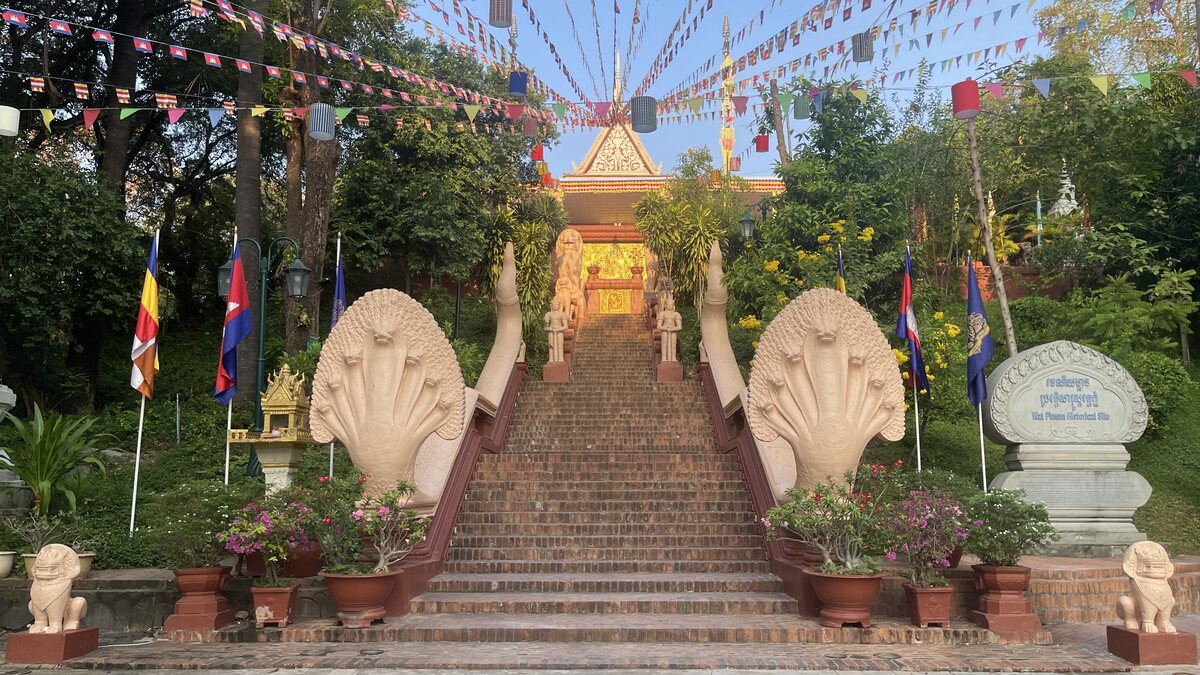
The structure is elevated above the ground and reached by a staircase flanked by guardian lions, a common feature in Khmer religious architecture.
In addition to the traditional Khmer elements, Wat Phnom also showcases subtle colonial influences.
During the French colonial period, renovations were made to the temple, including the addition of a European-style clock tower.
This fusion of local and foreign elements makes Wat Phnom a fascinating example of Cambodia’s historical journey through colonization and modernization.
The juxtaposition of these two distinct architectural styles also serves as a reminder of Cambodia’s complex and multifaceted history.
The traditional Khmer elements represent the resilience and endurance of Cambodian culture, while the colonial touches speak to the country’s struggles and adaptation during the French occupation.
This architectural fusion is not only aesthetically pleasing but also a testament to Cambodia’s rich and layered past.
The Stupa: A Beacon of Religious Reverence
At the heart of Wat Phnom stands the stupa, a key feature of Buddhist architecture.
This stupa is not only an architectural marvel but also a sacred relic housing the Buddha’s ashes and other significant relics.
It serves as a focus for worshippers, who come to pray, offer incense, and seek blessings from the Buddha.
The stupa is adorned with various statues, some of which depict the Buddha’s life, while others symbolize mythical creatures from Hindu and Buddhist mythology.
These creatures, such as garudas and nagas, are often seen as protectors of the Buddha and are believed to ward off evil spirits.
In addition to its spiritual importance, the stupa’s elevated platform offers stunning views of Phnom Penh, providing visitors with a glimpse of both the city’s modern vibrancy and its historical roots.


The Surrounding Grounds: A Tranquil Escape in the City
While Wat Phnom is situated in the heart of Phnom Penh, it offers visitors a peaceful respite from the city’s constant activity.
The temple grounds are surrounded by a beautiful garden, featuring lush greenery, ancient trees, and flowers.
These gardens not only add to the temple’s beauty but also provide a serene environment for meditation and reflection.
One of the most striking features of the temple grounds is the statues of sacred animals, which are often seen by visitors as symbols of protection and good fortune.
As you walk around the temple, you may encounter these figures, as well as offerings left by visitors seeking the Buddha’s blessings.
The large staircase leading up to the temple is flanked by stone lion statues, symbolizing strength and protection.
These lions are an important feature of Khmer architecture and are often seen guarding temples and other sacred sites.
Wat Phnom’s Cultural and Social Role
Beyond its religious importance, Wat Phnom plays a key role in the cultural and social fabric of Phnom Penh.
The temple is not only a site for spiritual worship but also a place for community gathering.
Local events, ceremonies, and festivals are often held at Wat Phnom, bringing together people from all walks of life to celebrate their shared cultural and religious heritage.
The temple is also a symbol of Cambodian identity.
As one of the oldest and most important religious sites in the capital, it represents the resilience of Cambodian culture through periods of war, colonization, and political upheaval.
Today, Wat Phnom continues to serve as a pillar of Cambodian heritage, a place where locals and visitors alike come to connect with the country’s deep-rooted traditions.
Notably, Wat Phnom is also home to various cultural activities that bridge the past and present.
For example, during the Cambodian New Year celebrations, the temple becomes a focal point for performances of traditional dance and music, offering visitors a chance to experience the vibrant cultural life of the Cambodian people.
In this way, Wat Phnom is not only a site for religious observance but also a space for cultural exchange and communal engagement.
Cambodia Bucket List was in Phnom Penh for Songkran (Khmer New Year). It is a must-do experience:


Visiting Wat Phnom in Phnom Penh: A Journey Through Time
For anyone visiting Phnom Penh, a trip to Wat Phnom is a must.
The temple not only offers a rich historical and cultural experience but also provides an opportunity to reflect on Cambodia’s complex past and present.
As you walk up the temple steps, take a moment to pause and appreciate the view, both of the temple itself and of the city surrounding it.
The entrance to the temple is lined with vendors selling incense, flowers, and offerings, allowing visitors to participate in the religious practices that take place at the site.
This experience creates a sense of connection with the local community and the temple’s spiritual atmosphere.
As you explore the temple grounds, you will find a mix of traditional Khmer statues, modern elements, and colonial influences.
The fusion of these styles offers a unique perspective on Cambodia’s cultural evolution, making Wat Phnom in Phnom Penh a truly remarkable place to visit.
Conclusion: Wat Phnom as a Symbol of Phnom Penh’s Identity
Wat Phnom is more than just a temple; it is a symbol of Phnom Penh’s rich history, cultural significance, and religious heritage.
From its legendary origins linked to the founder of the city to its contemporary role as a center of spirituality and community, Wat Phnom remains one of the most cherished landmarks in Cambodia.
The stunning architecture, tranquil surroundings, and deep-rooted religious and cultural significance make it a place of peace and reflection in the midst of the city’s hustle and bustle.
Whether you are a spiritual seeker, a history enthusiast, or simply a curious traveler, Wat Phnom offers something for everyone, making it a must-see destination in Phnom Penh.
Visiting Wat Phnom is a step back in time, a chance to connect with Cambodia’s past and witness its enduring cultural traditions.
It is a gateway to understanding Cambodia’s soul, offering insights into its spiritual life, its history, and its people.
When you find yourself in Phnom Penh, make sure to set aside time to visit this magnificent temple.
You will leave not just with stunning photos, but with a deeper appreciation for Cambodia’s vibrant and enduring cultural legacy.


It costs US$1 to enter. The ticket booth is immediately on your right, about five meters before you reach the stairs leading up to the temple.
Further Reading about Wat Phnom in Phnom Penh.
Ready for your next adventure?
Discover hidden gems, unforgettable experiences, and must-do activities in Phnom Penh and beyond.
👉 Explore more adventures in Phnom Penh
🇰🇭 Or uncover other epic destinations across the Kingdom of Wonder at Cambodia Bucket List
By following us, you’ll be the first to discover hidden gems, travel tips, and unforgettable experiences across Cambodia as we roll them out! 🇰🇭