Discover Wat Ounalom Monastery in this complete travel guide.
Nestled along the lively banks of the Tonle Sap River, just a short walk from the bustle of Sisowath Quay, stands one of Cambodia’s most revered and historically rich sites—Wat Ounalom Monastery.
Often overlooked by travelers racing between the Royal Palace and the city’s nightlife, Wat Ounalom offers something increasingly rare in modern travel: a window into a living spiritual tradition that continues to shape the cultural soul of Cambodia.
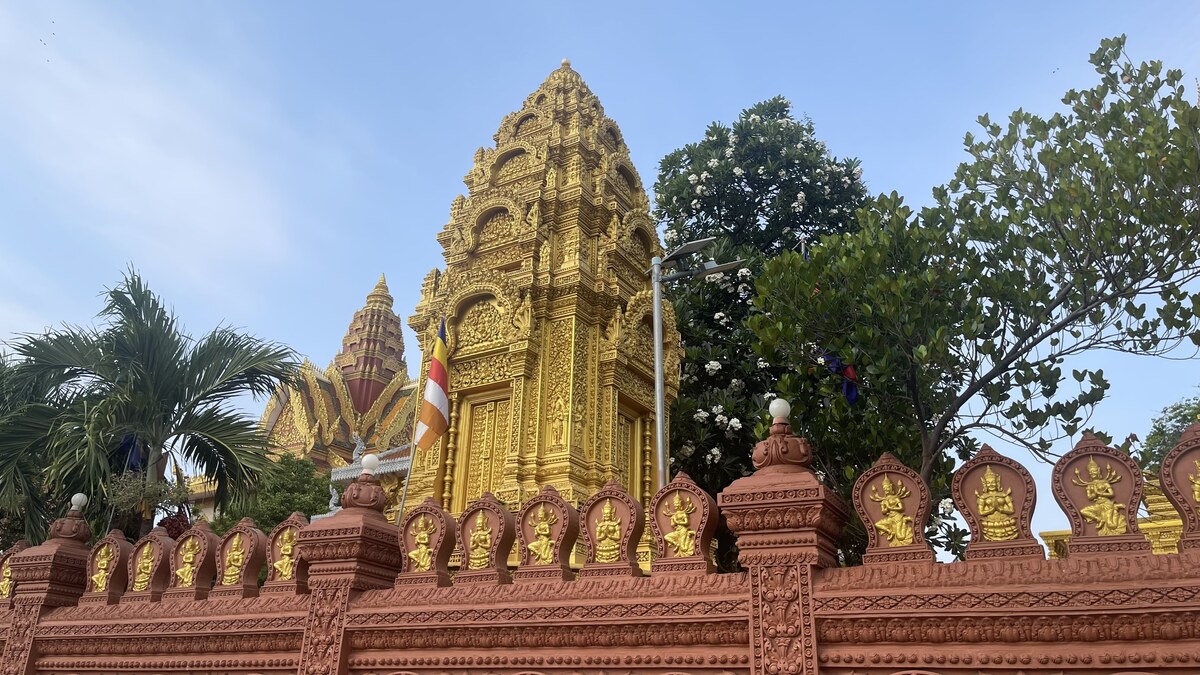
With its golden spires, peaceful courtyards, and saffron-robed monks, Wat Ounalom Monastery is more than just another temple. It is the epicenter of Cambodian Buddhism, a site of pilgrimage, and a sanctuary of resilience that has withstood war, genocide, and modernization.
A 15th-Century Legacy of Faith
King Ponhea Yat founded Wat Ounalom in 1443. It is one of the oldest and most historically significant pagodas in Cambodia.
Its original purpose was to serve as the center of Theravāda Buddhist education and practice, and to enshrine a revered relic—a single eyebrow hair of the Buddha—within its central stupa.
The name “Ounalom” comes from the Sanskrit Unaloma, referring to the symbolic spiral mark on the Buddha’s forehead, a representation of spiritual insight and awakening.
This seemingly small relic, believed to be housed within the main stupa, has drawn pilgrims and scholars for generations, anchoring the monastery’s significance not just in Phnom Penh, but throughout the entire country.


A Survivor of Tragedy and Triumph
Wat Ounalom’s history is marked by both spiritual grandeur and historical trauma.
In the mid-20th century, it was recognized as the spiritual headquarters of the Cambodian Mahanikaya sect, the largest monastic order in the country.
At its peak, it hosted not only monks but also scribes, translators, and scholars working to preserve ancient Buddhist texts and Khmer literature. However, everything changed during the Khmer Rouge regime (1975–1979).
Under Pol Pot’s brutal dictatorship, religion was outlawed. Monks were defrocked, tortured, and executed. Religious texts were burned. Temples, including Wat Ounalom, were desecrated or repurposed into storage depots, prisons, or administrative offices.
When the regime fell in 1979, what remained of Wat Ounalom was a shell of its former self. But in the decades since, the monastery has undergone an extraordinary rebirth.
After years of silence, monks gradually returned to the monastery. Chanting soon resumed, echoing through the restored prayer halls. Incense once again drifted across the courtyards, filling the air with familiarity and calm.
Today, Wat Ounalom stands not only as a temple but as a symbol of survival, resistance, and healing.
Wat Ounalom Monastery: A Living Monastery
What sets Wat Ounalom Monastery apart from many other temples in Phnom Penh is that it remains a living, breathing monastic community.
Unlike some heritage sites preserved in a kind of suspended animation for tourists, this temple is very much alive.
It is home to over 100 monks, from young novices just beginning their spiritual paths to elder monks who serve as mentors and leaders.
The temple also includes nunneries and religious schools, fostering the next generation of Buddhist leaders.


A Day in the Life at Wat Ounalom Monastery
At dawn, the temple awakens with the soft sound of bells and chanting. Monks gather in the vihara (main prayer hall) for morning meditation and Pali recitations.
As the city slowly comes to life, they begin their alms rounds, walking barefoot through Phnom Penh’s neighborhoods to collect food offered by lay supporters.
It is a daily act of humility and reciprocity, connecting the monastic community with the everyday lives of local Cambodians.
The rest of the day is filled with study, teaching, and temple maintenance. Visitors often see monks sweeping courtyards, arranging flowers at altars, or tutoring younger novices in Buddhist scripture.
For visitors, observing this daily rhythm offers a rare chance to see the continuity of ancient tradition in a modern urban setting.
Exploring the Temple Complex
Despite being in the heart of the city, the temple’s grounds offer a sense of tranquility. The compound is spacious and walkable, with a collection of stupas, halls, and shrines connected by shaded walkways and flower-lined paths.


Wat Ounalom Monastery: The Central Stupa
Devotees consider the central stupa the most sacred part of the monastery because many believe the central stupa houses the relic of the Buddha’s eyebrow hair.
Painted white and crowned with golden trim, the stupa exudes elegance without extravagance.
Locals often stop here briefly during their day to light incense, bow in prayer, or leave lotus blossoms at its base.
Wat Ounalom Monastery: Murals and Statues
The temple walls are adorned with vivid murals depicting the Jataka tales—stories of the Buddha’s previous lives.
These narratives serve not only as religious instruction but also as moral allegories.
Many visitors are struck by the detail and symbolism: tigers representing temptation, rivers symbolizing purification, and celestial beings watching from the corners of each story.
Statues of the Buddha in various mudras (hand gestures) can be found throughout the temple, representing different teachings—compassion, fearlessness, meditation, and enlightenment.
Wat Ounalom Monastery: Library and Archive Rooms
One of Wat Ounalom Monastery’s lesser-known treasures is its library, where monks and scholars study ancient texts.
Many of these were reprinted or restored after the Khmer Rouge destruction.
Monks and scholars use the building as a repository of Buddhist knowledge, preserving palm-leaf manuscripts, Pali scriptures, and classical Khmer literature.
Festivals and Ceremonies
Visiting Wat Ounalom Monastery during a Buddhist festival is an unforgettable experience.
Pchum Ben
The Festival of the Ancestors, held in September or October, is among the most important events in the Cambodian calendar.
For 15 days, Cambodians visit temples to make offerings for their departed relatives, believing that during this period the gates of the underworld are briefly opened.
During Pchum Ben, the temple becomes a hive of activity: families arrive bearing food, flowers, and incense; monks chant blessings; and the air becomes thick with reverence.
It’s a time of spiritual closeness between the living and the dead.
Vesak Day
Celebrated in May, Vesak commemorates the birth, enlightenment, and death of the Buddha.
On Vesak Day, it hosts processions where monks, nuns, and laypeople walk in meditative silence around the main stupa, each holding a single lit candle.
The ceremony is deeply symbolic—representing light dispelling darkness, and wisdom overcoming ignorance.
Etiquette and How to Visit Respectfully
Wat Ounalom Monastery welcomes the public and does not charge an entrance fee, but respectful behavior is essential.
Here are some tips to ensure your visit is culturally appropriate:
- Dress modestly: Both men and women should cover shoulders and knees. Light cotton clothing works well in Cambodia’s tropical climate.
- Remove your shoes and hat before entering prayer halls.
- Keep your voice low, especially during ceremonies or chanting.
- Don’t point your feet toward Buddha statues or monks—this is considered disrespectful.
- Avoid physical contact with monks, especially if you are a woman.
- Ask before photographing anyone, particularly monks or worshippers.
The temple welcomes visitors to sit quietly, observe, and even join in meditation.
Monks appreciate donations, especially when visitors light incense or request a blessing.
Wat Ounalom Monastery reflections from Travelers
Many visitors to Phnom Penh stumble upon Wat Ounalom Monastery by accident, only to find that it becomes one of the most memorable parts of their journey.
A traveler from Australia reflected:
“I’d seen so many temples across Southeast Asia, but Wat Ounalom felt different. It wasn’t trying to impress—it was just real. Watching young monks giggle between lessons while older monks chanted in the hall… it felt like I was witnessing something eternal.”
Another visitor from the U.S. shared:
“I went expecting to stay 20 minutes. I stayed two hours. I ended up meditating on a bench with a nun who offered me tea and a quiet smile. No words were exchanged, but it felt like a conversation. That memory has stayed with me.”
Wat Ounalom invites not just sightseeing, but stillness—a quality many travelers unknowingly crave.

Why Wat Ounalom Is So Much More Than a Temple
It would be easy to see Wat Ounalom as just another stop on a city tour. But doing so misses the point.
This is a place where Cambodia’s spiritual past and present merge, and ancient rituals continue to thrive. It’s a sanctuary shaped by resilience, where centuries of suffering have quietly given way to renewal.
Travelers—whether spiritual or simply curious—often discover an unexpected sense of connection and peace.
Unlike tourist-saturated sites, this monastery remains a sanctuary—not curated, not commodified, just quietly powerful.
If you’re willing to slow down, listen, and open your heart, Wat Ounalom will offer you something few places in Phnom Penh can: a genuine connection.
Planning Your Visit to Wat Ounalom Monastery
Location:
Street 172, near the Royal Palace and National Museum
Hours:
Typically open daily from 6:00 AM to 6:00 PM
Entrance Fee:
Free (donations welcome)
Nearby Attractions:
- The Royal Palace & Silver Pagoda
- The National Museum of Cambodia
- Wat Phnom
- Riverside cafes and markets
Wat Ounalom Monastery: Final Thoughts
In a city where history, trauma, and rapid development collide, Wat Ounalom Monastery stands firm. Not just as a monument to faith, but as a reminder of the power of compassion, tradition, and resilience.
Come for the history. Stay for the stillness. Leave with a story you didn’t expect to tell.
Further Reading about Wat Ounalom Monastery.
Ready for your next adventure?
Discover hidden gems, unforgettable experiences, and must-do activities in Phnom Penh and beyond.
👉 Explore more adventures in Phnom Penh
🇰🇭 Or uncover other epic destinations across the Kingdom of Wonder at Cambodia Bucket List
By following us, you’ll be the first to discover hidden gems, travel tips, and unforgettable experiences across Cambodia as we roll them out! 🇰🇭