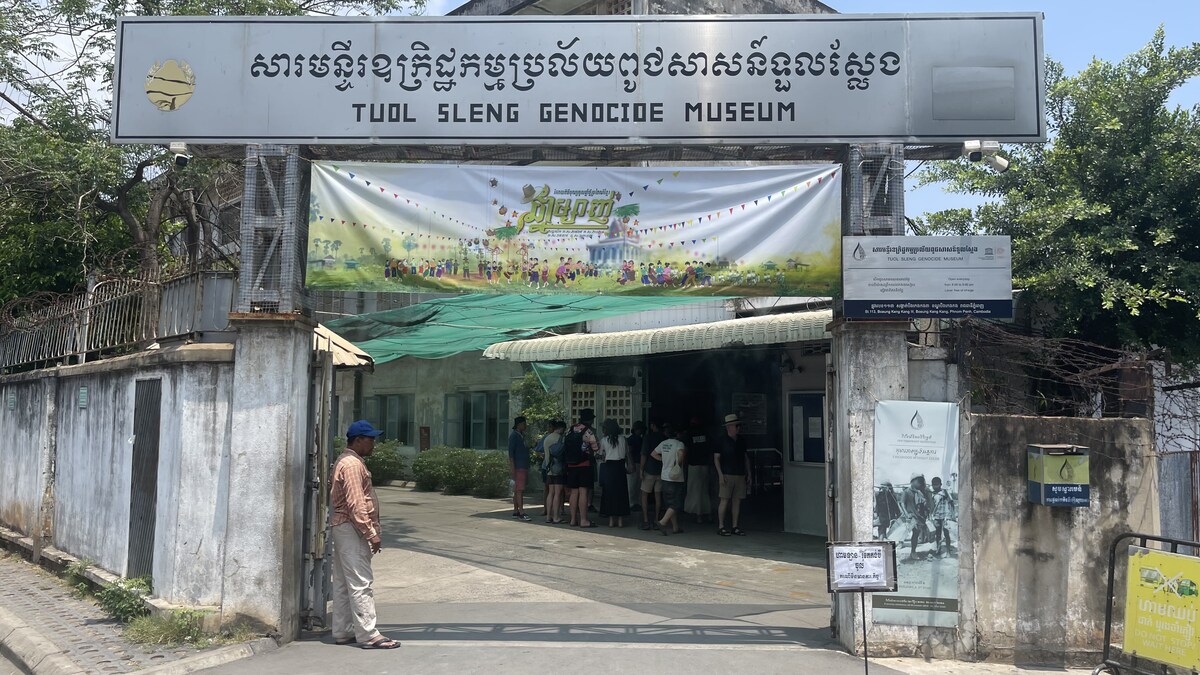
Tuol Sleng Genocide Museum: Cambodia’s Unforgettable Warning

Tuol Sleng Genocide Museum, formerly known as Security Prison 21 (S-21), is a chilling testament to Cambodia’s recent and harrowing history, tucked behind Phnom Penh’s bustling streets.

Originally a high school, this unassuming complex eventually became the epicenter of one of the most brutal regimes the world has ever seen—the Khmer Rouge.

Visiting Tuol Sleng is not a light experience; however, it is a necessary one.

Indeed, this museum doesn’t just preserve history—it confronts it head-on.

Moreover, it tells the story of a nation’s suffering, the atrocities committed within its walls, and the resilience of the survivors.

For those unfamiliar with Cambodia’s past, this introduction therefore provides a sobering yet vital starting point.

The Rise of the Khmer Rouge

To fully understand the significance of the Tuol Sleng Genocide Museum, we must first begin with the Khmer Rouge’s takeover of Phnom Penh in April 1975.

Led by Pol Pot, this radical communist movement seized power with promises of equality and national prosperity.

However, instead of delivering on these ideals, they unleashed a campaign of mass murder, forced labor, and ideological cleansing that devastated the country.

As soon as the Khmer Rouge took control, they immediately emptied the capital city.

Consequently, families were forced into the countryside to work in labor camps.

Furthermore, intellectuals, professionals, and anyone with ties to the previous government became targets.

In this climate, suspicion ruled the day.

Loyalty to the party was paramount—and always in question.

A corridor in Building A at the Tuol Sleng Genocide Museum.
A prison cell in Building A at the Tuol Sleng Genocide Museum.

From School to Prison: The Birth of S-21

The Khmer Rouge transformed Tuol Svay Prey High School into a secret detention and torture center.

Barbed wire enclosed the campus, cutting it off from the outside world.

Meanwhile, classrooms became prison cells.

In place of learning, chalkboards were removed and replaced with chains.

By renaming the site Security Prison 21, or S-21, the regime effectively erased its former identity and imposed a new, sinister purpose.

S-21 operated under the command of Kang Kek Iew, better known as Comrade Duch.

He ran the prison with meticulous cruelty.

Every prisoner was photographed, interrogated, and tortured.

Ironically, meticulous records were kept—a dark twist considering the regime’s disdain for knowledge.

Ultimately, Tuol Sleng functioned as more than a prison; it was a place of systematic extermination.

Victims were forced to confess to crimes they didn’t commit.

Once deemed guilty—inevitably—they were sent to the Killing Fields of Choeung Ek to be executed.

Inside the Walls of Horror

A visit to Tuol Sleng unveils the inhumanity that took place within its walls.

As soon as you step through the heavy gates, the atmosphere changes.

The tropical air stills.

The laughter of the city fades.

Instead, what remains is silence, and the weight of memory.

The museum preserves much of the site’s original layout.

To this day, classrooms turned into cells remain largely untouched.

Rusted bed frames, shackles, and bloodstains on tiled floors confront you at every turn.

These are not relics; rather, they are evidence—evidence of pain, fear, and death.

Grim photographs line the walls.

Rows upon rows of mugshots—men, women, and children—stare out, eyes wide with terror, confusion, or resignation.

Undeniably, these images are impossible to forget.

They are the last recorded moments of thousands of lives.

In another section, the museum contains graphic paintings by Vann Nath, one of the few survivors.

His artwork documents the torture he witnessed.

His brush became his voice—his only tool for sharing what he endured.

Without his work, many of the crimes might have remained hidden forever.

A Mechanism of Terror

Between 1976 and 1979, more than 18,000 people passed through Tuol Sleng.

Tragically, fewer than 20 survived.

The regime didn’t imprison only political enemies.

Instead, it targeted doctors, teachers, students, engineers, and even its own members.

Loyalty, it turns out, offered no protection.

In fact, families of prisoners were often detained and killed to eliminate all possible threats.

The methods of torture were horrific.

Interrogators used electrocution, waterboarding, beatings, and psychological torment.

Moreover, prisoners were kept in tiny, pitch-black cells.

Deprived of food, light, and human contact, they deteriorated quickly—physically and mentally.

The goal wasn’t just to extract information; rather, it was to break the spirit.

Once a confession was obtained, regardless of its truth, execution followed.

For the Khmer Rouge, a dead prisoner couldn’t conspire.

This system of manufactured guilt and automatic execution was designed to instill total fear.

It created a world where survival became random, and suspicion justified slaughter.

That this occurred within the walls of a school—a place once meant to nurture young minds—makes it all the more tragic.

A view of the corridor in Building B at the Tuol Sleng Genocide Museum.
A prison cell in Building B at the Tuol Sleng Genocide Museum.

Foreign Detainees: The Story of Western Nationals at Tuol Sleng

In addition to the countless Cambodians who were imprisoned and tortured at Tuol Sleng, there was also a group of Western nationals who tragically became victims of the Khmer Rouge regime.

In 1978, Kerry Hamill, a 28-year-old New Zealander, and John Dewhirst, a 26-year-old Brit, were captured after their boat veered into Cambodian waters while fleeing from Vietnam.

Paranoid about foreign influences and the potential for espionage, the Khmer Rouge detained them, despite their civilian status.

Both men were sent to S-21, where they were interrogated, tortured, and forced to make false confessions.

Their tragic fate highlights the regime’s indiscriminate cruelty and its refusal to differentiate between foreign and Cambodian lives.

Ultimately, these Western detainees serve as a stark reminder of the far-reaching impact of the Khmer Rouge’s reign of terror, where even foreigners were not spared from suspicion, brutality, and death.

From Secret Facility to Museum of Memory

When the Vietnamese army invaded Phnom Penh in January 1979, they discovered Tuol Sleng abandoned.

Inside, they found bodies still chained to beds, photographs, and thousands of pages of records.

Although the regime had fled, the evidence of their crimes remained.

In the aftermath, Cambodian officials made a bold decision: they would not erase S-21’s past.

Instead, they would preserve it.

In 1980, the site reopened as the Tuol Sleng Genocide Museum.

The goal was not revenge—it was remembrance.

By turning the prison into a museum, Cambodia took a brave step toward truth.

Survivors wanted the world to know what had happened.

They hoped future generations would learn, question, and ensure that such horrors never return.

Planning Your Visit: What to Expect

Located in central Phnom Penh, the Tuol Sleng Genocide Museum is easily accessible and open to the public throughout the year.

Despite its grim history, the museum is respectfully maintained and welcomes visitors with empathy and care.

Entrance Fees and Opening Hours

  • General admission: $5 USD
  • Audio guide (highly recommended): $5 USD additional
  • Opening hours: 8:00 AM – 5:00 PM (last entry at 4:15 PM)
  • Closed on major Cambodian public holidays

Audio guides are available in multiple languages, providing rich historical context, survivor testimonies, and detailed explanations of exhibits.

This guide is especially valuable for first-time visitors unfamiliar with the Khmer Rouge period.

The corridor in Building C at the Tuol Sleng Genocide Museum show individual wooden cell doors.
A solitary confinement cell in Building C at the Tuol Sleng Genocide Museum.

Tuol Sleng Genocide Museum Key Exhibits and Areas to Explore

Tuol Sleng Genocide Museum | Building A: Torture Chambers

This block contains large rooms with metal bed frames, chains, and instruments of torture.

Behind each bed, a haunting photograph hangs on the wall, showing exactly how the room was discovered.

These images, taken by Vietnamese soldiers in 1979, offer chilling, visual confirmation of the atrocities committed here.

Tuol Sleng Genocide Museum | Building B: Mugshots and Documentation

Rows of black-and-white photos line the walls—each a life cut short.

In addition, you will find prisoner biographies, Khmer Rouge records, and interrogation documents.

Remarkably, these chilling files were preserved in detail, offering a disturbing yet vital record of what occurred.

Tuol Sleng Genocide Museum | Building C: Cells and Solitary Confinement

Narrow brick and wooden cells fill this section.

As you explore, the oppressive layout offers insight into the dehumanizing conditions endured by prisoners.

Without a doubt, walking through these claustrophobic corridors is profoundly unsettling—and unforgettable.

Tuol Sleng Genocide Museum | Building D: Survivor Accounts and Artwork

Here, you’ll find artwork by Vann Nath and personal testimonies from survivors.

Together, these displays humanize the statistics, reminding us that behind each number was a real person with a story.

Why You Should Visit the Killing Fields After Tuol Sleng Genocide Museum

While the Tuol Sleng Genocide Museum lays bare the intellectual and emotional destruction of the Khmer Rouge era, a visit to the Killing Fields of Choeung Ek completes the story—through the lens of its final, physical brutality.

After confessing under torture, most prisoners were transported by truck to Choeung Ek, a peaceful-looking site just 15 kilometers outside Phnom Penh.

There, in the dead of night, they were executed en masse and buried in mass graves.

The regime often used blunt instruments, farming tools, or machetes to carry out killings, conserving bullets for only the most “important” victims.

Today, Choeung Ek is a place of stillness and sorrow.

A striking memorial stupa filled with more than 5,000 human skulls marks the site.

As visitors walk, they follow worn paths that pass open pits—once mass graves—and see bone fragments and clothing still surfacing after heavy rains.

It is a visceral reminder of what occurred after S-21.

Together, Tuol Sleng and the Killing Fields deliver a full-circle understanding of the Khmer Rouge’s machinery of death.

To see one without the other is to know only half the tragedy.

Visiting both not only honors the victims—it transforms the visitor.

Barbed wire in place of windows in Building C obstruct the view of modern Phnom Penh.
A remembrance structure has been erected on the grounds of the former S-21 prison camp, remembering all who were tortured and died here.

A Personal Reflection: Why Tuol Sleng Genocide Museum Matters Today

Visiting the Tuol Sleng Genocide Museum is not an act of dark tourism.

Rather, it is an act of respect.

It acknowledges the suffering endured by thousands and honors their memory.

For Cambodians, this museum is not just a site of loss—it is a place of truth.

In today’s world, where historical denial and revisionism persist, museums like Tuol Sleng are vital.

They hold power because they make denial impossible.

The pain is there.

The evidence is clear.

The silence of the victims echoes through the halls.

For visitors, the experience can be emotionally overwhelming.

It is normal to feel disturbed, saddened, even sickened.

Importantly, these reactions are valid—and necessary.

They reflect a conscience, a capacity for empathy, and a commitment to justice.

The Tuol Sleng Genocide Museum doesn’t just make you think—it makes you feel, deeply and unforgettably.

Ultimately, it confronts every visitor with the cost of extremism and the fragility of humanity when ideology supersedes compassion.

Survivors and Justice: The Legacy Lives On

Only a handful of people survived Tuol Sleng.

Among them was Vann Nath, whose art and voice brought global attention to the Khmer Rouge’s crimes.

Another survivor, Chum Mey, still occasionally speaks to visitors, sharing his story with heart-wrenching honesty.

Meanwhile, the pursuit of justice continued through the Extraordinary Chambers in the Courts of Cambodia (ECCC), commonly called the Khmer Rouge Tribunal.

In 2010, Comrade Duch was tried and sentenced.

Subsequently, other leaders followed, although many escaped prosecution.

These trials underscore the importance of historical accountability.

Moreover, they highlight Cambodia’s ongoing journey to reconcile with its painful past.

Tips for Visitors: How to Prepare Emotionally and Culturally

First and foremost, approach the museum with respect.

Dress modestly, speak quietly, and refrain from taking selfies.

To get the most from your visit, allow enough time to explore all the buildingsat least 1.5 to 2 hours is recommended.

If possible, consider visiting Choeung Ek (the Killing Fields) on the same day to complete your understanding of the genocide.

Afterward, give yourself space to reflect.

The experience can be intense, so plan some quiet time or a peaceful activity to help process what you’ve seen.

Tuol Sleng Genocide Museum | Conclusion: A Journey Through Memory and Mourning

The Tuol Sleng Genocide Museum is not a place one “enjoys.”

Instead, it is a place one endures, absorbs, and remembers.

It forces us to confront the capacity for cruelty—and the importance of vigilance, empathy, and remembrance.

For many, visiting Tuol Sleng becomes a turning point.

It shifts understanding, adds depth to one’s worldview, and instills a profound respect for Cambodia’s resilience.

If you visit only one historical site in Cambodia, make it this one.

The Tuol Sleng Genocide Museum doesn’t just teach you history—it shows you why history must never be forgotten.

Official website: https://tuolsleng.gov.kh/

Cambodia Bucket List has had the honor of visiting the Tuol Sleng Genocide Museum on multiple occasions.

Each time, like many others, we are profoundly moved by the experience.

Our visits are undertaken out of deep respect for the Cambodian people and in solemn remembrance of the countless victims who endured the atrocities of the Khmer Rouge regime.

Today, Cambodia stands as a nation transformed—a country that bears the scars of its past yet continues to move forward with strength and dignity.

It is our intent to both honor the memory of the victims and celebrate the resilience of the living.

S-21 Khmer Rouge Prisoner 408.
S-21 Khmer Rouge Prisoner 413.
S-21 Khmer Rouge Prisoner 374.
S-21 Khmer Rouge Prisoner 209.
S-21 Khmer Rouge Prisoner 311.
S-21 Khmer Rouge Prisoner - 25-9-78.
S-21 Khmer Rouge Prisoner 235.
S-21 Khmer Rouge Prisoner 169.
A Phnom Penh female street hawker - profile photo taken in 2025.
A Phnom Penh male construction worker - profile photo taken in 2025.
A Phnom Penh female owner of a crafts center - profile photo taken in 2025.
A Phnom Penh male organic shop worker - profile photo taken in 2025.
A Phnom Penh male security guard - profile photo taken in 2025.
A Phnom Penh female working at the Central Market - profile photo taken in 2025.
A Phnom Penh male restaurant worker - profile photo taken in 2025.
A Phnom Penh female working at a coffee shop - profile photo taken in 2025.
Survivor of S-21, Chum Mey, at the Tuol Sleng Genocide Museum in Phnom Penh.

Ready for your next adventure?

Discover hidden gems, unforgettable experiences, and must-do activities in Phnom Penh and beyond.

👉 Explore more adventures in Phnom Penh

🇰🇭 Or uncover other epic destinations across the Kingdom of Wonder at Cambodia Bucket List

By following us, you’ll be the first to discover hidden gems, travel tips, and unforgettable experiences across Cambodia as we roll them out! 🇰🇭

Trending

Discover more from Cambodia Bucket List

Subscribe now to keep reading and get access to the full archive.

Continue reading