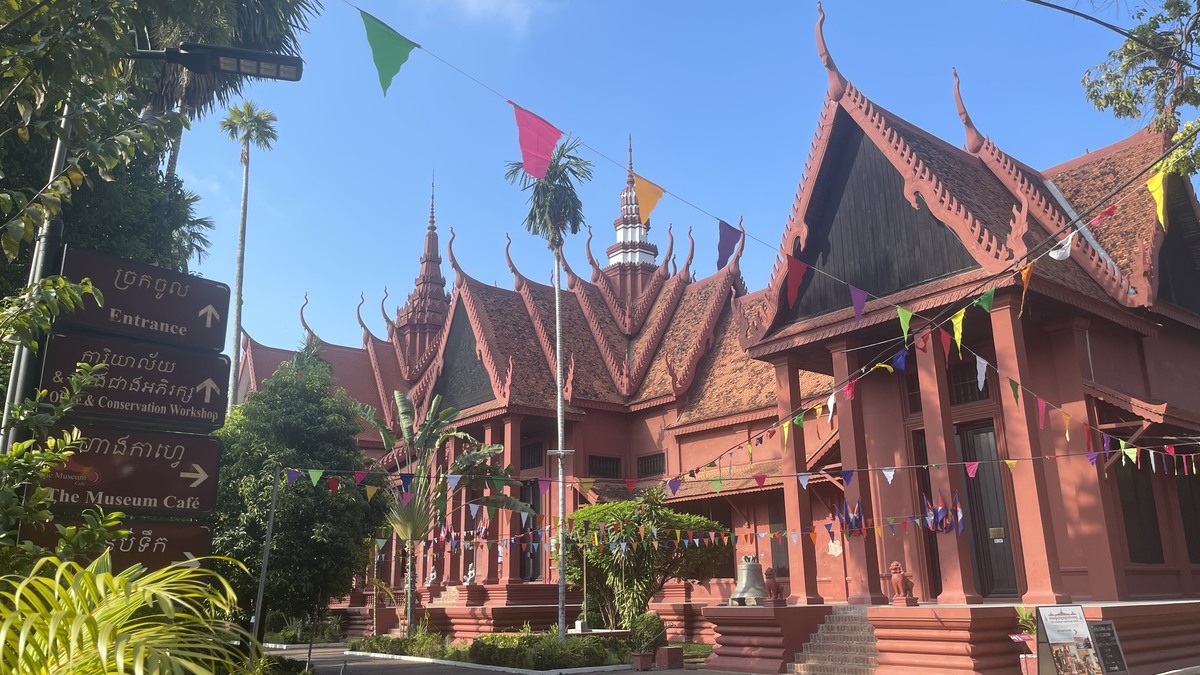
The National Museum of Cambodia: An iconic museum in Phnom Penh.
Located in the heart of Phnom Penh, just steps from the Royal Palace, the National Museum of Cambodia showcases the nation’s rich cultural heritage.
Its terracotta pavilions and traditional Khmer roofs reflect the creativity and resilience of the Cambodian people.
This museum preserves centuries of artistic and historical treasures.
A walk through its galleries reveals a journey from the early days of the Khmer Empire to Cambodia’s modern artistic revival.
A Brief History of the National Museum of Cambodia
The National Museum of Cambodia first opened to the public in 1920, during the French colonial era.
Its creation came largely through the efforts of George Groslier — a French scholar, historian, and archaeologist dedicated to preserving Cambodian art and history.
Groslier imagined a grand space to protect the kingdom’s precious relics, many of which were disappearing or ending up in foreign collections.
Blending French and Khmer architectural styles, the museum emerged as a beacon of cultural conservation.
Despite years of war and political turmoil, the museum survived.
Even under the Khmer Rouge regime (1975–1979), when cultural and educational institutions were being destroyed, the museum’s artifacts remained mostly intact — a rare preservation during a time of widespread cultural destruction.


Architecture: A Reflection of Khmer Aesthetics
The museum building is a true masterpiece.
Designed in traditional Khmer style, the deep red walls create a striking contrast with the surrounding green gardens and lotus ponds.
Its sloping, multi-tiered roofs with elegant, upturned corners are unmistakably Cambodian, echoing the design seen in ancient temples like those at Angkor.
Walking through the museum feels like stepping into a peaceful monastic complex.
Open-air corridors lined with statuary invite visitors to move slowly and thoughtfully, connecting with both the exhibits and the spirit of Cambodian artistry.


Treasures Within: The Collections
The National Museum holds the world’s largest collection of Khmer art, featuring artifacts that span from prehistoric times to the post-Angkorian period.
The National Museum of Cambodia Pre-Angkorian Artifacts
An extraordinary collection of Pre-Angkorian artifacts, tracing the roots of Cambodia’s rich cultural heritage, are housed in the National Museum of Cambodia.
Dating back to the 4th century, some of the earliest pieces in the collection offer a rare glimpse into the artistic, spiritual, and technological expressions of early Cambodian civilizations.
Visitors can explore intricately carved sandstone sculptures, finely crafted bronze tools, and beautifully glazed ceramic wares, each bearing testimony to the sophistication and ingenuity of their creators.
Far more than decorative objects, these artifacts reflect a time when animism and the worship of natural forces shaped every aspect of daily life.
For early communities, reverence for rivers, animals, trees, and celestial bodies formed the basis of spiritual belief.
Experts suggest these spiritual practices laid the foundation for the introduction and assimilation of Hinduism and Buddhism, which became central to the Khmer Empire’s cultural identity.
Through close study of their stylistic details, researchers have uncovered links between regional design elements and evolving religious symbolism.
Guests at the museum often marvel at the precision and emotional depth captured in these works, which reflect a profound connection to both nature and spiritual meaning.
Still resonating with power today, these pieces embody Cambodia’s enduring cultural resilience and ancestral wisdom.
The Golden Age: Angkorian Masterpieces
The centerpiece of the museum’s collection is an astounding array of Angkorian-era art.
From the 9th to the 15th century, the Khmer Empire produced some of the world’s most sophisticated sculpture, and the museum showcases this artistic zenith.
Highlights include the monumental statue of Vishnu from the West Mebon temple—a serene yet powerful depiction of the Hindu god—and the imposing likeness of Jayavarman VII, the Buddhist king who oversaw the empire’s greatest period of expansion and architectural achievement.
Reliefs, lintels, and architectural fragments from Angkor Wat, Bayon, and other sacred sites are displayed with care, offering visitors a close look at the grandeur and complexity of Khmer religious art.
Post-Angkorian and Modern Works
The museum’s story continues beyond the fall of Angkor.
Later periods, influenced by Theravada Buddhism, are represented through delicate wood carvings, bronze Buddhas, and intricately decorated ceramics.
The museum also highlights modern and contemporary Cambodian art, acknowledging the ongoing creativity in Cambodian culture.
These newer works explore themes of memory, survival, and national identity, especially in the aftermath of the Khmer Rouge era.


Artifact Recovery and Repatriation Efforts
After decades of turmoil, countless Cambodian artifacts were looted and sold abroad.
In recent years, the National Museum has worked tirelessly, often alongside international organizations, to recover and repatriate these stolen treasures.
Each returned artifact represents a victory for cultural sovereignty and an important step toward rebuilding Cambodia’s historical narrative.
Significant recoveries include statues from the Koh Ker temple complex and priceless ceremonial objects, many of which are now proudly displayed in the museum’s “Recovered Treasures” wing.
The Role During the Khmer Rouge Era
During the brutal Khmer Rouge regime, almost every symbol of Cambodia’s history and culture was targeted.
Amazingly, the museum’s collection survived mostly intact, thanks to a small group of caretakers who risked their lives to protect these artifacts.
Their heroic perseverance remains a powerful testament to the resilience of Cambodian identity in the face of devastation.
Today, the museum honors these quiet heroes with a memorial plaque and special exhibits that recount this dark yet defiant chapter.
Education and Conservation
Beyond its role as an exhibition space, the National Museum of Cambodia is a key center for education and conservation.
It features a conservation laboratory focused on preserving ancient artifacts, many of which require careful attention due to their age and fragility.
The museum also offers training programs for young Cambodians in fields like archaeology, museology, and art restoration.
These programs are crucial in a country still recovering from the loss of its intellectual and cultural leaders during the 20th century.
International partnerships, especially with institutions in France, Japan, and the United States, have enhanced the museum’s ability to protect and share Cambodia’s heritage globally.
Visitor Tips and Hidden Gems
Early Morning Visits: Arrive early to enjoy the peaceful atmosphere before the crowds.
Hidden Courtyards: Explore off the main paths to discover smaller courtyards filled with rare statues and hidden ponds.
Photography Nooks: While photography is restricted inside the galleries, the courtyards provide stunning photo opportunities.
Talk to the Guides: Museum guides often share personal stories and lesser-known historical facts that can enrich your visit.
The National Museum of Cambodia Events and Performances
The National Museum also acts as a vibrant cultural hub.
Regular performances of traditional Khmer dance, often held in the museum’s courtyard, offer visitors the chance to experience Cambodia’s living cultural traditions.
These performances are not mere re-enactments but are deeply connected to Cambodia’s spiritual and artistic heritage.
Special exhibitions, lectures, and educational programs enhance the museum’s offerings throughout the year, making it a dynamic space that continues to evolve.
Challenges and the Future
Despite its many achievements, the National Museum of Cambodia faces ongoing challenges.
Funding for conservation projects remains a constant need, and the pressures of modernization in Phnom Penh threaten the preservation of historic sites and cultural spaces.
However, the museum has ambitious plans for the future.
Efforts are underway to digitize the collection, making it accessible to a global audience.
Expansion and modernization plans aim to enhance the visitor experience while preserving the museum’s historic charm.
Additionally, there is a growing focus on repatriating Cambodian artifacts from foreign museums and private collections.
As Cambodia’s cultural renaissance continues, the National Museum is set to play a central role in reclaiming and celebrating the full breadth of its heritage.
Practical Information for Visitors
Location: Corner of Street 13 and Street 178, Phnom Penh
Opening Hours: 8:00 AM – 5:00 PM daily (last admission at 4:30 PM)
Admission Fee: US$10, with discounts for students and locals
Dress Code: Modest attire is encouraged to respect the cultural setting
Photography: Allowed in the courtyard but restricted inside the galleries
Official Website: https://www.cambodiamuseum.info
When Cambodia Bucket List visited the National Museum of Cambodia, we were discouraged from taking any photographs within the museum complex, including the courtyard.
Instead, we focused on photographing the public-access areas of the museum gardens, which were just as beautiful and filled with iconic statues.
Access to the museum gardens is free, offering a peaceful oasis of shade and tranquility in the heart of bustling Phnom Penh.
We returned one day, an hour after sunrise, when the museum was officially closed.
However, we were granted free access to the gardens and captured photographs in the soft morning light.


The National Museum of Cambodia: Conclusion
The National Museum of Cambodia is more than a repository of ancient relics; it is a living monument to the enduring spirit of the nation.
Within its red walls and verdant courtyards, the soul of Cambodia whispers through stone, bronze, and wood.
For those seeking to understand the depths of Khmer civilization, or simply to experience the profound beauty of Cambodian art, a visit to the National Museum is a must.
It stands as a place of memory, learning, and inspiration — a timeless treasure in the heart of Phnom Penh.
From the peaceful lotus ponds to the awe-inspiring statues that gaze serenely across centuries, every part of the National Museum of Cambodia invites visitors to pause, wonder, and connect with a civilization that, though tested by time, continues to shine brightly into the future.
Ready for your next adventure?
Discover hidden gems, unforgettable experiences, and must-do activities in Phnom Penh and beyond.
👉 Explore more adventures in Phnom Penh
🇰🇭 Or uncover other epic destinations across the Kingdom of Wonder at Cambodia Bucket List
By following us, you’ll be the first to discover hidden gems, travel tips, and unforgettable experiences across Cambodia as we roll them out! 🇰🇭