Echoes of Silence: Uncovering the Truth Behind Phnom Penh’s Killing Fields
The Killing Fields, located just outside Phnom Penh, stand as one of the most harrowing reminders of Cambodia’s brutal past.
A once-quiet countryside site, Choeung Ek became a mass graveyard under the Khmer Rouge regime.
Between 1975 and 1979, Pol Pot’s dictatorship executed over one million Cambodians, many of whom first endured imprisonment and torture at the notorious S-21 Tuol Sleng prison.
Further Reading: https://cambodiabucketlist.com/tuol-sleng-genocide-museum/

This article traces the path from Tuol Sleng to Choeung Ek.
Along the way, it describes the horrific experiences of the victims, explores challenges in preserving this historic land, and examines the controversial yet crucial decision to invite the world to witness this site firsthand.


From Tuol Sleng to Choeung Ek
The Road to Execution
Initially a high school, S-21 Tuol Sleng transformed into a torture facility after the Khmer Rouge seized Phnom Penh in April 1975.
The regime, under Pol Pot, aimed to create an agrarian utopia by purging the population of “enemies” of the revolution.
Intellectuals, professionals, former soldiers, and even children found themselves detained in this grim institution.
Once inside Tuol Sleng, prisoners underwent days or weeks of interrogation and torture.
The regime extracted confessions through electrocution, waterboarding, beatings, and starvation.
Detainees, broken in body and spirit, were labeled traitors—whether guilty or not.
Loyalty to the regime could not save the imprisoned.
Even Khmer Rouge soldiers were accused arbitrarily by paranoid leaders.
The revolution consumed its own.
Following a forced confession, the next step arrived swiftly.
In the cover of darkness, guards loaded the condemned onto trucks.
No explanation or trial preceded their departure from Tuol Sleng.
Their destination: Choeung Ek, one of many execution fields around Cambodia.
A One-Way Journey
Trucks rolled out regularly.
Prisoners, often blindfolded and shackled, had no idea where they were headed.
Prisoners assumed they might be transferred to another prison.
Upon arrival at Choeung Ek, hope vanished.
Soldiers herded victims off the vehicles and led them directly to pits.
Executions occurred immediately.
In the regime’s eyes, a “confessed traitor” required no further delay.
They did not waste bullets.
Instead, guards used blunt instruments—hoes, axes, bamboo poles—to kill swiftly and silently.
Victims died quickly but brutally.
Many faced death beside their own family members.
A few tried to protest.
Many begged for mercy.
Yet the guards, conditioned by fear, followed orders without hesitation.
Life (and Death) at the Killing Fields
A Grim Operation
Choeung Ek was not only a killing ground; it was a systematized death camp.
Here, Khmer Rouge cadres operated under strict instructions.
No emotion.
No deviation.
Every prisoner had to be killed.
The guards received quotas and followed them without question.
Executioners buried victims in mass graves.
Graves held hundreds of bodies.
Others, reserved for children and infants, lay beside the infamous “Killing Tree,” where soldiers smashed babies against the bark before tossing the corpses into a nearby pit.
This cruelty shocked even some of the guards, yet the killing persisted relentlessly.
At times, a few guards suffered breakdowns, overwhelmed by the sheer brutality they were forced to carry out.
Yet, replacements were always available.
Compassion had no place here.
Silence and Secrecy
The Khmer Rouge shrouded Choeung Ek in secrecy.
The site, once a Chinese cemetery, stood isolated enough to prevent escape or exposure.
To mask the screams, they played loud propaganda music through speakers strung between trees.
Generators powered these recordings, blaring over the fields as the killing occurred behind a curtain of sound.
Victims’ personal belongings, collected before execution, were discarded.
Occasionally, guards stole jewelry or clothing.
Most often, items were buried or burned.
The regime didn’t care about possessions.
Silence was their goal.
Compliance was demanded.
No trace was to be left behind.
Villagers nearby occasionally heard distant cries and music but dared not ask questions.
Fear of suspicion silenced everyone.
Human Remains and Evidence
In the early 1980s, after the Khmer Rouge fell, Cambodian authorities began unearthing mass graves.
What they found stunned even those familiar with the atrocities.
Skulls cracked by blunt trauma.
Bones tangled with rope.
Clothing scraps still clinging to skeletons.
Tools of execution buried beside the bodies.
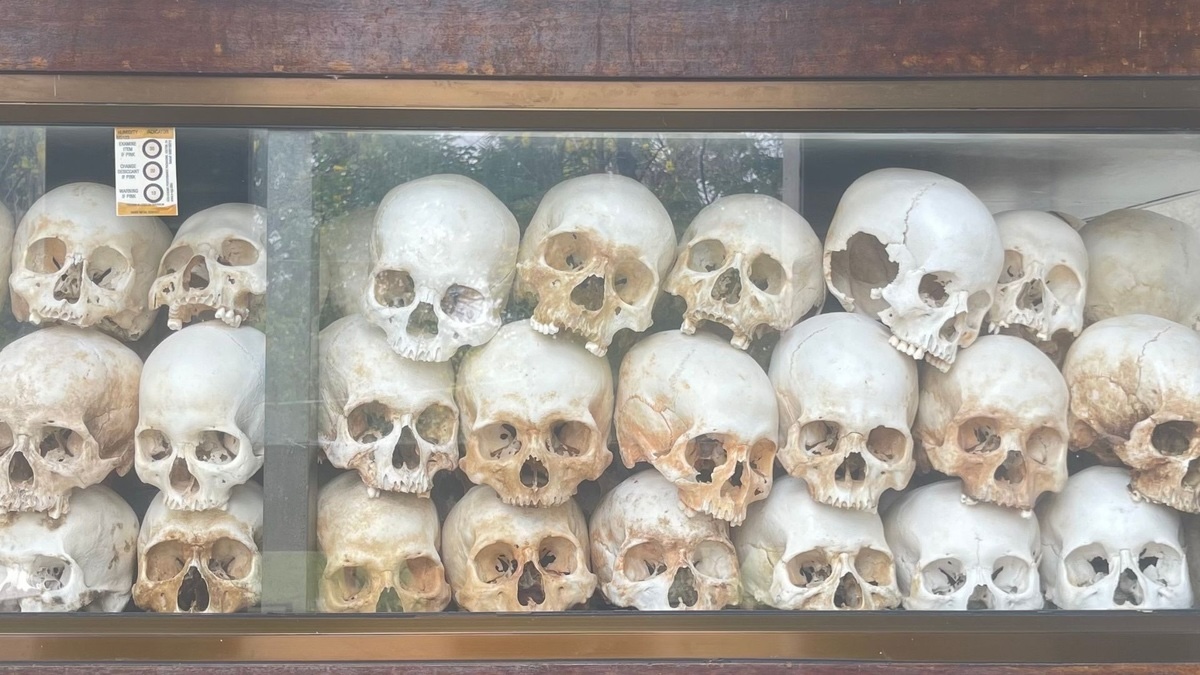
Researchers eventually uncovered more than 8,000 skulls at Choeung Ek.
These relics now sit on display in a memorial stupa built to honor the dead.
Transparent panels showcase the skulls, each bearing visible wounds.
Though deeply disturbing, the memorial offers a visceral reminder of the horror that took place.
Visitors leave flowers.
Others write notes.
The air hangs heavy with mourning, and the silence honors those who never had a voice.
Preserving the Killing Fields Choeung Ek Today
Challenges of Maintenance
Maintaining the Killing Fields is no simple task.
The land itself resists restoration.
After decades of weather and erosion, human bones still rise to the surface after rainfall.
Visitors often report finding teeth, rib fragments, or cloth sticking out of the dirt.
Volunteers and staff collect these remains daily with utmost care.
Environmental factors pose an ongoing threat.
Heavy monsoons flood the graves, High heat and humidity further accelerate deterioration.
Local caretakers use modest resources to manage the site, but the challenges remain constant.
The caretakers cannot fence off the entire area, nor can they exhume every grave.
Despite these difficulties, Cambodia continues to safeguard this land.
International partnerships and donations help maintain the dignity of the site.
Ethical Dilemmas in Preservation
Beyond the physical challenges lie ethical questions.
How should a country preserve a site of such immense trauma?
Should it be left untouched, or curated for public viewing?
Cambodia has chosen to balance remembrance with education.
The result is a site that neither sanitizes the past nor sensationalizes it.
Audio tours lead visitors through the fields, narrating survivor testimonies, historical facts, and personal reflections.
These stories ensure that visitors understand the depth of suffering without descending into voyeurism.
The atmosphere remains quiet, and signs request silence.
Every step invites contemplation.
Education becomes a tool for healing, as future generations risk repeating the past without understanding it.


Tourism and the Killing Fields
Why Invite the World?
Critics argue against promoting Choeung Ek as a tourist destination.
Yet, Cambodian officials and survivors view education as a path to healing.
By inviting visitors, they aim to spread awareness and prevent future atrocities.
The international presence, they believe, validates the suffering and honors the victims.
Furthermore, tourism helps fund preservation.
Donations from visitors support the upkeep of the memorial stupa, the maintenance of gravesites, and the staffing of educational programs.
Although money alone cannot restore dignity, it enables sustainable management and global education.
Survivors often say that forgetting is more painful than remembering.
The Killing Fields force the world to confront the truth.
Lessons for Future Generations
The Killing Fields offer more than a history lesson.
They warn against unchecked power, blind ideology, and indifference.
Many visitors leave changed—shaken, somber, but also aware.
Schools bring students, while veterans return to pay respects.
Families of survivors find closure among the graves.
For Cambodia, confronting this legacy is essential.
The country continues to deal with the psychological trauma passed down through generations.
Public acknowledgment, both domestic and international, builds a bridge between past and present.
Through this, Cambodians reclaim their narrative and share it with the world.
Only by exposing evil can societies cultivate peace.
These fields, though silent, continue to speak truth.
Conclusion: Remembering to Never Forget
Choeung Ek’s Killing Fields reveal a story not only of death, but also of resilience.
Victims did not die in vain.
Their legacy lives on in the hearts of those who walk the grounds, listen to the stories, and carry the memory forward.
From Tuol Sleng’s prison walls to Choeung Ek’s silent graves, the journey reflects the worst of human cruelty—but also the power of remembrance.
Tourists do not come to gawk.
Instead, they come to learn and to feel.
Most importantly, they come to ensure that never again becomes more than a phrase—it becomes a promise.
The silence of the Killing Fields shouts louder than any history book ever could.


FAQs About Visiting the Killing Fields
Where is Choeung Ek located?
The site lies about 15 kilometers south of Phnom Penh, accessible by tuk-tuk, bus, or taxi.
Most visitors combine their visit with a trip to Tuol Sleng Genocide Museum, which provides essential context.
Is the site appropriate for children?
Due to the graphic and emotional nature of the content, many families wait until children are in their teenage years.
However, audio guides provide tailored experiences based on age and sensitivity.
How long should a visit take?
On average, visitors spend 1.5 to 2 hours at Choeung Ek.
The audio tour enhances the experience, guiding guests through each section at a solemn pace.
How to Prepare for Your Visit to the Killing Fields
- Wear respectful clothing (covered shoulders and knees).
- Bring tissues—many find themselves moved to tears.
- Listen carefully to the stories told in the audio tour.
- Remain silent throughout your walk; the field is a sacred space.
By walking through these fields, you do not simply witness history—you honor it.
You carry the weight of memory.
And you leave with a clearer understanding of what must never happen again.
Official Website: https://www.cambodianmuseum.org/remembering-the-killing-fields
Ready for your next adventure?
Discover hidden gems, unforgettable experiences, and must-do activities in Phnom Penh and beyond.
👉 Explore more adventures in Phnom Penh
🇰🇭 Or uncover other epic destinations across the Kingdom of Wonder at Cambodia Bucket List
By following us, you’ll be the first to discover hidden gems, travel tips, and unforgettable experiences across Cambodia as we roll them out! 🇰🇭